Friday, July 31, 2009

Habits for Creating

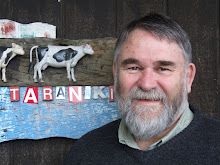
Paul Hutchinson and Dale Copeland create - habitually!
Check out Dale's web site for the latest Virtual Tart exhibition and Paul's painting a day [now that's creative habit for you!]

From Dale: "The exhibition for September on http://virtual.tart.co.nz is Introversion Boxes, by Lisa Mei Ling Fong of San Francisco. I met Lisa at as Assemblage Exhibition in Berlin and have long admired her work. (And envied her too, for living close to The Bone Room, which must be the best shop in the world if you're an assemblage artist!)And while you're on the site, have a look around the Showcase ... there's new work there from me, from Anne Holliday, from Tony Rumball, Sharyn Lee Hoskin .....You might be interested: Paul has been trying to break into the USA art world. He has sold two of his small painting-a-day works on eBay, and has just put another one on.
All of the small paintings are on his http://postcardfrompuniho.blogspot.com site and his latest eBay one is on http://cgi.ebay.com/ws/eBayISAPI.dll?ViewItem&item=150362559587
It's a big market out there, and lots of different ways to find your audience."

Thursday, July 30, 2009

The 100 most creative people in business

according to Fast Company.
http://www.fastcompany.com/100/

What is Creativity?

UK teachers share their thoughts on what creativity is and how it can be supported in the classroom.
http://www.guardian.co.uk/education/video/2009/jun/16/a-z-creativity
And while you are on the site check out the Creative Summer video clips.

Reawakening the Creative Mind

From the BBC - Interesting!
http://news.bbc.co.uk/2/hi/science/nature/1932709.stm

Hands Up: Who KIlled Creativity?

"We could be facing a crisis in creative confidence. With budgets slashed and resources cut, many people are being asked to do more with less – but few feel adequately equipped. The future will clearly require superior innovative thinking and problem solving skills, and yet so many feel paralyzed to act quickly and confidently when it comes to finding new ideas and solutions. Who is to blame for the apparent crisis in creative development? And how can leaders create and nurture an environment that supports creative thinking and development?"

Check out some answers to these questions in this article by Andrew and Gaia Grant.
http://www.tirian.com/media/t-thoughts-072009.html

When underdogs break the rules.

This from my friend Fraser Buchanan - an article by Malcolm Gladwell in The New Yorker - How David Beat Goliath.
Click here: http://www.newyorker.com/reporting/2009/05/11/090511fa_fact_gladwell

Monday, July 27, 2009

Fostering Creative Minds

With literacy and numeracy given top priority in schools, and the Government's push for new national academic standards, are our kids having their creativity educated out of them? MICHELLE DUFF of the Manawatu Standard reports.

Little kids will draw anywhere they can.
A scrawl on the wallpaper, a dash on the table. A swirl of something in their mashed potato and gravy at dinner.
Forget pencils and crayons they will make something out of anything. Egg cartons, uncooked macaroni, leaves, shells, wool, iceblock sticks, playdough.
Give a kid materials and some spare time, and he or she will make you their version of a masterpiece.
"Children are born with a huge amount of creativity," says Geoff Lovegrove, principal of Feilding's Lytton Street primary school.
"A little kid can create anything out of anything.
"They are hugely creative when they are young, and somehow they lose that when they are about 16 as a process of their schooling, it's drilled out of them."
These concerns are being discussed by teachers throughout the country, as the Ministry of Education narrows its focus on literacy and numeracy in schools.
In May, the Government announced a new set of national standards, due to be finalised at the end of 2010.
These standards will measure academic achievement in reading, writing and mathematics, in every pupil aged 5 to 12.
Though the Government says these standards will be used to provide clearer indications of children's progress, teachers are less convinced. They fear data collected on pupils could be used to create "league tables", ranking schools on their performances.
And some, like Mr Lovegrove, say a New Zealand curriculum that already focuses almost "single-mindedly" on literacy and numeracy, is cheating kids out of a holistic education.
"That is the difficulty, that's what worries us," Mr Lovegrove says.
"For some years, primary schools have been told we must focus on literacy and numeracy which is quite right, the reading, writing and maths side of the curriculum is critical.
"But we know how important art is, especially for children.
"There are so many children whose achievement comes out through the arts if they are excelling at visual arts, drama or music, we can hit on that as something to celebrate and draw them out with, and then they will excel at other things as well."
At the International Conference of Principals in Singapore last week, Mr Lovegrove was concerned by speeches given by top primary school educators.
Principals from the United States and Britain spoke of their frustration at the pressure placed on their schools to achieve high results in standardised maths, reading and writing tests, he says.
"We don't want to go down a path that overseas schools have gone down, and realise there are so many kids who could be excelling in the arts, but they don't get the chance because of the fear of the national testing.
"Their whole school arts programmes are being shot to pieces or not funded because they're focusing single-mindedly on their test results, and that's sad."
And kids love art.
The New Zealand National Education Monitoring Project (NEMP), run by Otago University since 1995, shows visual art is ranked by Year 4 children as their second most popular subject.
At the same time, the survey recorded declining levels of art ability in both Year 4 and Year 8 students.
In the 2007 survey, art-making efforts of students at Year 4 received global ratings of fair, poor and very poor 75 per cent to 90 per cent of the time, rarely receiving marks of very good or excellent. Year 8 results were only slightly better.
It doesn't stack up, College Street Normal School principal Ross Kennedy says, and it's time that something was done.
"We need to be fostering the creativity of the kids far, far more than we have been in the past 20 or 30 years.
"We need kids who can think creatively and outside the square, especially to deal with issues coming up in the future, like sustainability and conservation.
"Unless we give kids the opportunity to really get involved in the areas they are passionate about, this isn't going to happen."
Most primary school teachers are "generalists" who do a good job at teaching everything, but might not actively encourage artistic talents, he says.
A recent Sunday Star Times report says trainee primary school teachers are receiving a decreasing amount of art training.
As a result, children might be missing out on creative and critical thinking skills, it says.
Massey University College of Education senior art lecturer Paul Hansen says the total hours spent teaching the arts including visual art, drama, music and dance has reduced over the years.
This is partly to do with the curriculum focus on literacy and numeracy, he says.
But it is also because, with the introduction of a new four-year degree, the course is moving from the traditional single-subject focus to a more interdisciplinary approach.
Today, teachers should be thinking of ways they can incorporate art into everything they do whether it be a science, maths, or writing topic, he says.
And art lessons should be worked into other units, to make connections with other subjects.
With so much media around kids in their everyday lives, schools have to be more innovative, Mr Hansen says.
"We've got to find ways of engaging them. It's not surprising kids can get turned off if they're not in an environment that doesn't stimulate them.
" `No sames,' that's my motto - colouring in photocopies is not art education.
"You need to do something the children can respond to and connect with in an individual way," Mr Hansen says.


Reprinted with permission from Michael Cummings Editor Manawatu Standard

Fostering Creative Freedom

Director, producer, actor and musician Penni Bousfield is the programme leader for UCOL's Certificate in Performing Arts. [Palmerston North, New Zealand] That's Penni on the left of the photo at her recent birthday celebrations - age unknown of course!!]. She invited MICHELLE DUFF of the Manawatu Standard into her workspace.

"This is our drama studio, you can see we have the dance bars on the walls and nice wooden floor, and there's a mirror that runs along the end wall. It's where we have most of our acting and voice classes. This is an old industrial building, for UCOL it was the automotive workshop, so it can get a bit cold in the winter and hot in the summer. But it has a nice feel to it.
I've been here for two-and-a-half years. I came up here from Wellington where I'd been working as a freelance director and producer. During that time I'd been up here as a visiting artist at Massey, I did Summer Shakespeare one year. I've always had an interest in performing, singing and I was lucky enough to go to a primary school where that was valued.
Music was the main thing for me, I was a professional musician for most of my 20s. A bunch of us started doing stand-up comedy and did a national tour; it regenerated my interest in theatre. I went home and did a drama degree. It's a bit of a backwards career trajectory I did a tour then went to drama school, it's meant to be the other way around.
My official title is programme leader. I take acting and voice production, and I direct the end-of-semester show, which is the musical theatre component. It's a six-month course. At one extreme people are just doing the course to get confidence, and others want to get into drama school and see this as good preparation.
The students say I get really, really excited when somebody gets it. It's great seeing someone taking a big step forward or a group coming up with something brilliant, that I never would have thought of. I try to do things that encourage people's creativity, if you're just working on stagecraft you're not going to know how to do your own street theatre, or comedy, or experimental stuff.
I've had students here who spent the first few weeks looking at me and saying "you are the mad lady and you're making us do crazy stuff", but at the end of the course it's pretty clear they have developed. If anyone walked in here during a class they would think they'd walked into a Victorian mental institution people are slithering around on the floor making a variety of noises, absolute bedlam is the only way to describe it.
You are your own instrument - that old cliche - so we are working on that, and the work can go into quite personal areas at times. It is a case of you are your own raw material, you are your own tools. I always say when they say "this is hard" I never told you it would be easy."

Reprinted with permission from Michael Cummings Editor Manawatu Standard

Sunday, July 26, 2009

Art of the Song Creativity Radio

I have talked about Art of the Song Creativity Radio in a previous blog.

It had been a little while since I had been back to their site www.artofthesong.org. WOW!!!
I thought it was great when I first visited but now there is so much more. Hosted by Vivian Nesbitt and John Dillon - both of whom have their own blogs that are worth following - John's is at http://www.findyourcreativity.wordpress.com/ and Vivian's at http://www.creatingrealitythroughaction.blogspot.com/ - the site is a veritable feast of creativity - too much to talk about here so just go to http://www.artofthesong.com/ and check it out for yourselves. Superb!!

Performance Anxiety?

In Ten Zen Seconds, Dr. Eric Maisel marries Eastern mindfulness practices and Western cognitive psychology and positive psychology techniques to produce a brand new way of thinking about mindfulness and a new mindfulness practice. Ten Zen Seconds has come from his work with thousands of creative clients in his creativity coaching practice and field tested worldwide.
Eric is the author of more than thirty books. He holds Bachelor’s degrees in Philosophy and Psychology, Master's degrees in Creative Writing and Counseling, and a Doctorate in Counseling Psychology. He is a marriage and family therapist, a creativity coach and trainer of creativity coaches, a columnist for Art Calendar Magazine, provides regular segments for Art of the Song Creativity Radio, and teaches Ten Zen Second techniques through lectures, workshops, and tele-seminars.
Eric is widely regarded as America's foremost creativity coach and has taught thousands of creative and performing artists how to incorporate Ten Zen Second mindfulness techniques into their creativity practice. Check it out at http://www.tenzenseconds.com/
His other books are well worth reading and you might even consider signing up as a client [for free with a coach in training] on his creativity coach training programme.

More about this on http://www.ericmaisel.com/